


The United Nations Secretary-General concluded a three-day official visit to Lebanon on Tuesday by reiterating his call for the country's political leaders to fulfill their responsibility to their people.
“People expect their political leaders to listen to their needs and restore the economy, to have a functioning government with state institutions, and to fight corruption effectively,” António Guterres stressed at a press conference in Beirut at the end of his activities in Lebanon.
Speaking to reporters, Guterres said the country's leaders must work to implement reforms that respond to the Lebanese people's demands for greater well-being, accountability, protection , and transparency in order to restore hope for a better future.
In addition, they need to start formal negotiations to finalize the agreement with the International Monetary Fund quickly and without further impediments in order to boost the recovery.
“Lebanese leaders have no right to divide and paralyze the country ,” the UN chief insisted, highlighting the suffering of the population.
Institutions must deliver results
He noted that government institutions are measured based on their results in social protection , access to electricity and water, education and basic medical care, good governance and protection of human rights.
Guterres stated that to achieve these positive results and pave the way for a sustainable recovery, it is essential to include civil society, women, and young people in decision-making and policy development.
Lebanese leaders have no right to divide and paralyze the country.
He believed that the parliamentary elections to be held in May 2022, as assured by the leaders he spoke with, would be a great opportunity for the people to make their voices heard, for the government to respect that demand, and to generate confidence that the constitution would be respected.
Referring to his visit to the port of Beirut, he again pointed out that the Lebanese, and especially the victims, deserve the answers and justice that can only be obtained through an impartial, thorough and transparent investigation.
crisis and recovery
The effects of that catastrophe on the economy have been devastating. Lebanon is experiencing a deep economic and financial crisis, leaving more and more people in need of humanitarian assistance.
“Yesterday I visited Tripoli in the north of Lebanon and today Tire in the south. I was very moved to hear the testimonies about how this crisis is affecting people's daily lives,” said the Secretary General.
In this regard, he stressed that the UN and the international community remain committed to helping promote a sustainable recovery and an inclusive and dignified future for the country , but lamented that the humanitarian response program has received only 11% of the required funds despite the dramatic situation of the Lebanese people.
“The international community must be prepared to substantially increase its solidarity with Lebanon in implementing the reforms needed to stabilize the economy and address the basic needs of the Lebanese people,” he emphasized.
He added that there are several initiatives to hold a resource mobilization conference, although he warned that it will be difficult for the international community to respond if it sees that the country remains paralyzed, without progress on the necessary reforms, and without a credible economic recovery plan.
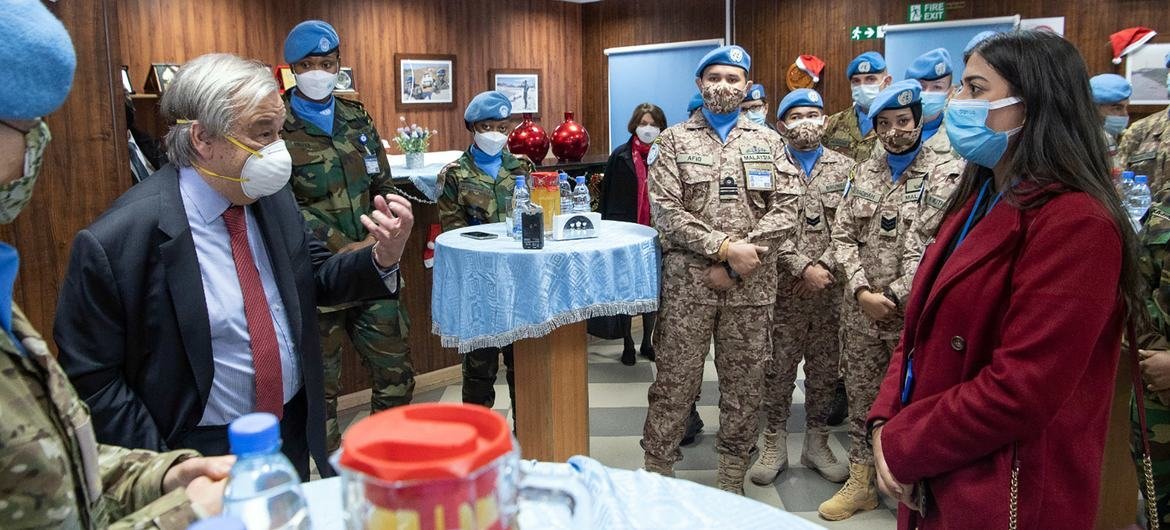
UN / Eskinder Debebe
Secretary General António Guterres talks in Lebanon with Aya Farhat, interpreter for UNIFIL.
Israel's Unacceptable Violations
Regarding the violations of territory, waters and airspace committed by Israel in the Blue Line, which transgress UN Security Council resolution 1701 , he asserted that all of them are “unacceptable”.
Guterres also alluded to the origin of the problem and reiterated the United Nations' commitment to the two-state solution, Palestine and Israel.
“We are fully committed to a Palestinian state , created and recognized in accordance with the resolutions of the General Assembly and the Security Council, and living in peace and security with the State of Israel and, of course, with the guarantee that the integrity of Lebanon will be respected,” he added.